What Are Competencies?
“Competencies are knowledge, values, abilities, and behaviours that help an individual contribute to or successfully engage in a role or task.” Seemiller, C. (2013) p. XV.
M-LEAD has identified a CORE set of leadership competencies that we believe are important for students to develop in order to enhance their abilities to lead change. The competencies are focused in the four main areas of communication, organizational development, reflection and emotional intelligence.
The Student Leadership Competencies Guidebook (2013) by Dr. Corey Seemiller serves as the framework for our leadership competencies and how we define them. We have focused on 12 competencies from the 60 identified by Dr. Seemiller. Each of our leadership offerings in Student Life has specific competencies that students learn about and develop during that offering.
Visit our programs page to sort our offerings by competency.
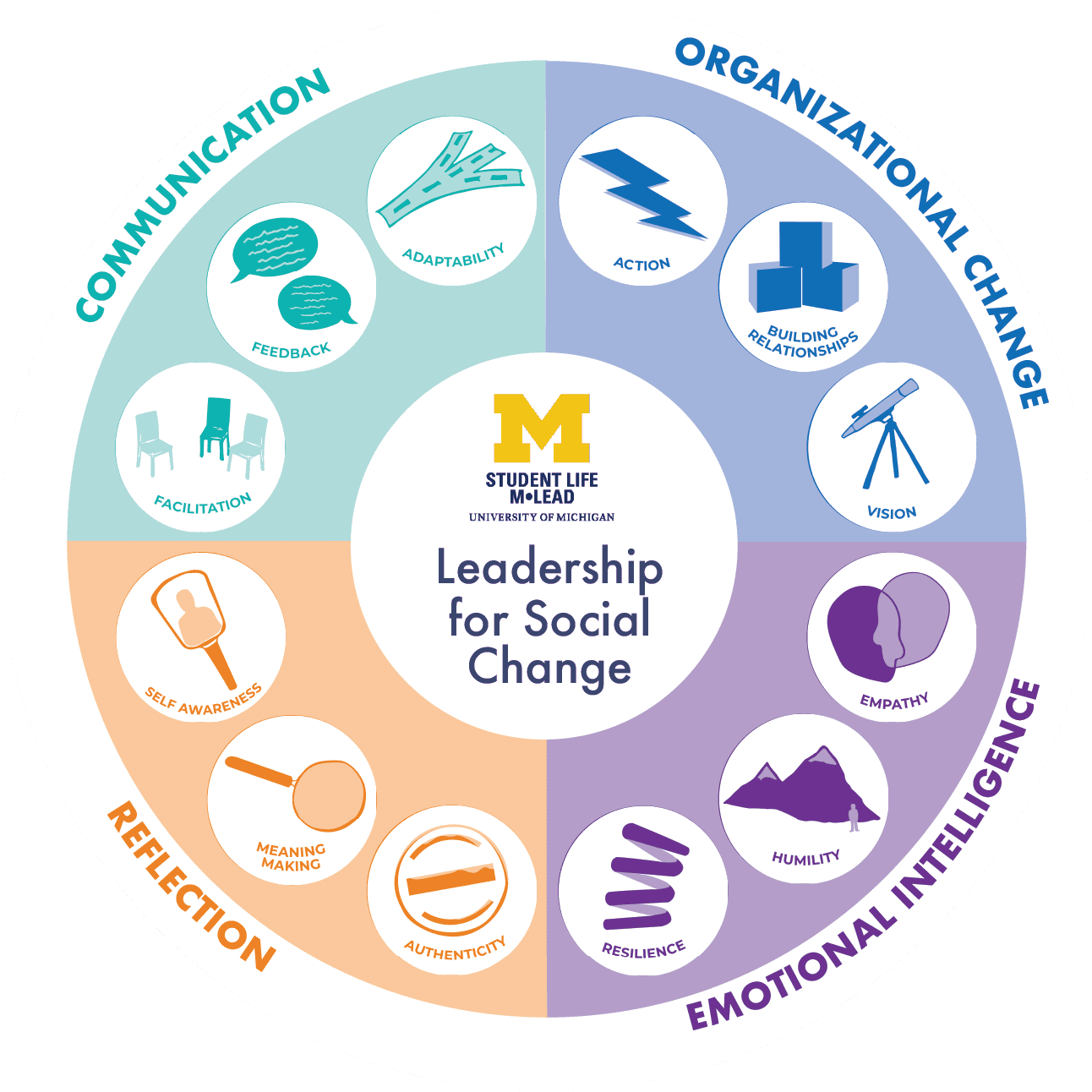
M-LEAD CORE Competencies
Click on each competency to view relevant opportunities!
Under each competency, we have also compiled a list of resources specifically related to each of our core leadership competencies.
LEGEND:
- i (individual) = resource intended for individuals
- g (group) = intended for group development
- c (community) = intended for community development
Communication
Adaptability Resources
- Change and Flexibility (Leah Linsalato) (i)
- Adapting to Change Requires Flexibility (Center for Creative Leadership) (i)
- What are you willing to give up to change the way we work? (Martin Danoesastro) (i)
- Developing a resilient, adaptable workforce for an uncertain future (Jacqueline Brassey, Aaron De Smet, Dana Maor) (i)
- From Resistance to Embrace: How Understanding Change Psychology Transforms Organizations (Villanova University) (i)
- How to Lead in a Crisis (Amy Edmondson) (i)
- Case Study (i/g/c)
Facilitation Resources
- IGR Working Paper Series (i)
- LSA Inclusive Teaching Resources (i/g)
- Developing Facilitation Skills (Community Tool Box, University of Kansas) (c)
- Facilitation Competencies (INIFAC) (i/g)
- Facilitation Tools (Training for Change) (i/g/c)
- Case Study (i/g/c)
- IGR Insights (i)
Feedback Resources
- Providing Feedback to Improve the Initiative (Community Tool Box) (c)
- Understanding People’s Needs (Community Tool Box) (c)
- Run, hide, or say thank you: When faced with feedback, what do you do? (Joy Mayer, Director, Columbia Missourian) (i)
- Giving and Receiving Feedback (The Washington Nonprofit Institute) (g)
- How To Give Feedback Most Effectively (Center for Creative Leadership) (i)
- The Power of Positive Feedback (Noriko Makino-Villanti) (i)
- Learning From a Mistake (Leadership in Focus) (i)
- Case Study (i/g/c)
Organizational Change
Action Resources
- Identifying Action Steps (Community Tool Box, University of Kansas) (c)
- The Science of Taking Action (Steve Garguilo) (i)
- Small Consistent Actions (Sam Demma) (i)
- Decision-Making for Leaders (Center for Creative Leadership) (i)
- Leading Social Change (Leadership in Focus) (i)
- Direct Action Tools (Training for Change) (i/g/c)
- Case Study (i/g/c)
Building Relationships Resources
- How to Build Human Connection at Work, at Scale (Center for Creative Leadership) (i/c)
- Stewardship: Building Power without Using Authority (Zingerman’s) (i/g)
- Building Bonds (Leadership in Focus) (i)
- Four Steps to Building the Psychological Safety That High-Performing Teams Need (Amy Edmondson) (i/c)
- Case Study (i/g/c)
Vision Resources
- Proclaiming Your Dream (Community Tool Box, University of Kansas) (c)
- SMART Goals (DecisionSkills) (i/g)
- Developing a Vision Statement (Pepperdine University) (i)
- Why and How Visioning Works (Zingerman’s) (i/g)
- The Power of Visioning (Zingerman’s) (i/g)
- Direction + Alignment + Commitment (DAC) = Leadership (Center for Creative Leadership) (i/g)
- 3 Things that Make a MEANINGFUL Vision (Simon Sinek) (i)
- Case Study (i/g/c)
Reflection
Authenticity Resources
- Authenticity on One’s Own Terms (Patricia Hewlin, Associate Professor, McGill University) (i)
- Leading from Vulnerability and Authenticity (Jim Hume, Founder and Principal of Phire Branding) (i)
- What Is Authentic Leadership, and Why Does It Matter? (Center for Creative Leadership) (i)
- What is Ethical Leadership and Why Is It Important? (Harvard DCE) (i/c)
- Case Study (i/g/c)
Meaning Making Resources
- Meaning-making and the language of leadership (Jenny Perkins, The HR Director) (g)
- Be a Facilitator of Meaning-Making: Incorporate Reflection in your Program (Guide Inc) (g)
- Reflector’s Toolkit (University of Edinburgh) (i/g)
- What is Experiential Learning? (Institute for Experiential Learning) (i)
- The Power of Meaning (Emily Esfahani Smith) (i)
- Case Study (i/g/c)
Self-Awareness Resources
- Reflecting for self-awareness (University of Edinburgh) (i)
- Self-Awareness Worksheet (Destiny’s Odyssey) (i)
- Become An Authentic Leader: Be Self-Aware (Lead Read Today, Ohio State University) (i)
- Mindfulness: defeating distraction and amplifying awareness (Richard Chambers, Monash University) (i)
- Weighing Principles (Leadership in Focus) (i)
- 3 ways to achieve self-awareness—and become a better leader (i)
- My experience with raising self-awareness (Giahnnii Paraku) (i)
- Case Study (i/g/c)
Emotional Intelligence
Empathy Resources
- Empathy is our Superpower (Anita Nowak, Author) (i)
- Empathy (Brene Brown, Professor, University of Houston) (i)
- What Students Say Builds Character in College (UC Berkeley, Greater Good Science Center)
- The War for Kindness: Building Empathy in a Fractured World (Jamil Zaki, Associate Professor, Stanford University) (i)
- Commitment to Empathy (Jamil Zaki, Associate Professor, Stanford University) (i)
- Case Study (i/g/c)
Humility Resources
- Blame (Brene Brown, Professor, University of Houston) (i)
- The Power of Humility (Ernest Fokoue, Professor, University of Rochester Institute of Technology) (i)
- Are You Taking 100% Responsibility? (The Conscious Leadership Group) (i)
- Mindfulness and Community Building (Community Tool Box) (c)
- Edgar Schein’s Humble Inquiry (Edgar Schein, Psychologist) (i/g)
- Case Study (i/g/c)
Resilience Resources
- The Road to Resilience (American Psychological Association) (i)
- The Secrets and Science of Mental Toughness (Joe Risser, Professor, UC San Diego) (i)
- Developing a Growth Mindset (Carol Dweck Professor, Stanford University) (i)
- Humor Me: The Surprising Link Between Laughter and Resilience (The Lincoln Center for Family and Youth) (i)
- Resilience (Katie Oblie) (i)
- Building Resilient Communities (Nick Tilsen, Executive Director, Thunder Valley CDC) (c)
- Community Resilience Tools & Resources (Center for Community Resilience) (c)
- Leadership Resilience (Center for Creative Leadership) (i)
- Understanding Resiliency and Capitalizing on Adversity (Justin Stoddard) (i/g)
- Case Study (i/g/c)
Why Competencies?
Having this set of competencies allows educators in Student Life to use consistent language, measurements and activities across our many units that do leadership education. This also allows our students to select offerings based on what competency or competencies they are looking to develop.
“Because the use of competencies is commonplace in many professional organizations (Ammons-Stephens, Cole, Jenkins-Gibbs, Riehele, & Weare, 2009) and in nearly 75 percent of businesses (Conger & Ready, 2004), focusing on competency development in college will allow students to become familiar with the process and language of competencies prior to entering their career field.” Seemiller, C. (2013) p. XVI.
Search Competencies by Career Field
In 2011, the Top Companies for Leaders Study found that nearly 75% of the 478 major global businesses they studied use competencies (Burns, Smith, & Ulrich, 2012). These include IBM, General Mills, and Proctor & Gamble (The RBL Group, 2012). Competencies are not only used by businesses; they are prevalent in the public sector and nonprofits as well, including the United States Army (2012), the United States Department of State (n.d.), and the YMCA (2010). Seemiller, C. (2018) Enhancing Leadership Competencies for Career Readiness.
Use the Student Leadership Competencies Database to find leadership competencies associated with your future career field.